
The Science
Peptides are fragile. Most storage isn’t.
Reconstituted peptides are not pantry goods. They are sensitive biochemical structures that lose potency under conditions most fridges, drawers, and travel cases create every single day. This page explains what is actually happening to your compounds, and why the DB90 was engineered around it.
01, Degradation
What heat actually does to peptides
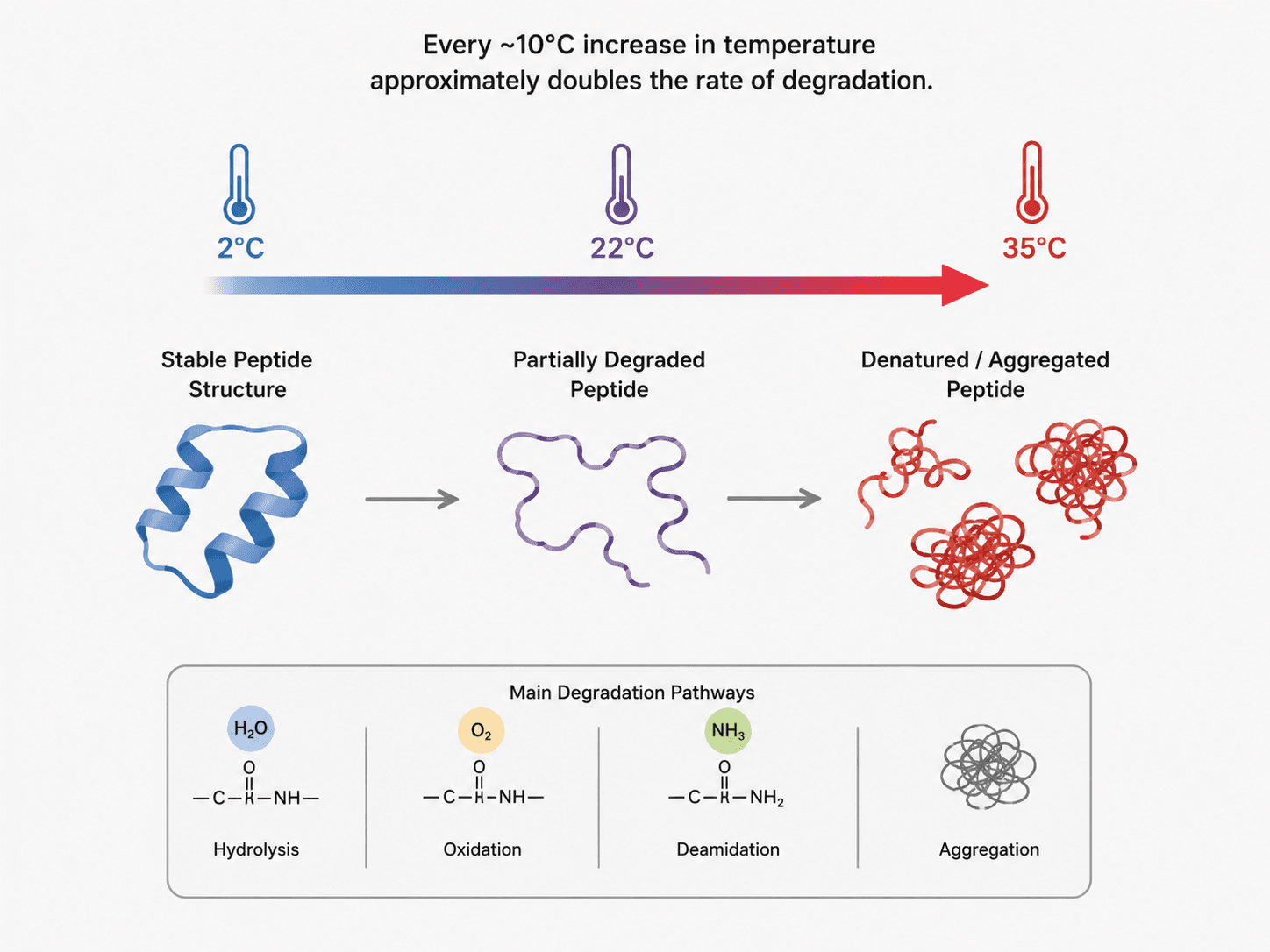
Peptides are short chains of amino acids, protein fragments held together by peptide bonds and a specific three-dimensional fold. That structure is what makes them biologically active. Disrupt the structure and you do not get a damaged peptide; you get a different molecule entirely.
Temperature accelerates that disruption through several mechanisms: hydrolysis, where water cleaves the peptide bond; oxidation, especially at methionine and cysteine residues; deamidation; and aggregation, where denatured peptides clump together into inactive forms. None of these processes are visible. A vial that looks identical to the day you reconstituted it can have measurably less activity inside.
The general principle from pharmaceutical stability science: across the ranges that matter for storage, every roughly 10°C increase in temperature approximately doubles the rate of these reactions. A vial sitting at 22°C is degrading several times faster than one held at 2°C. A vial in a sun-warmed car at 35°C is in a different category altogether.
02, The Fridge Problem
Why a kitchen fridge is not enough
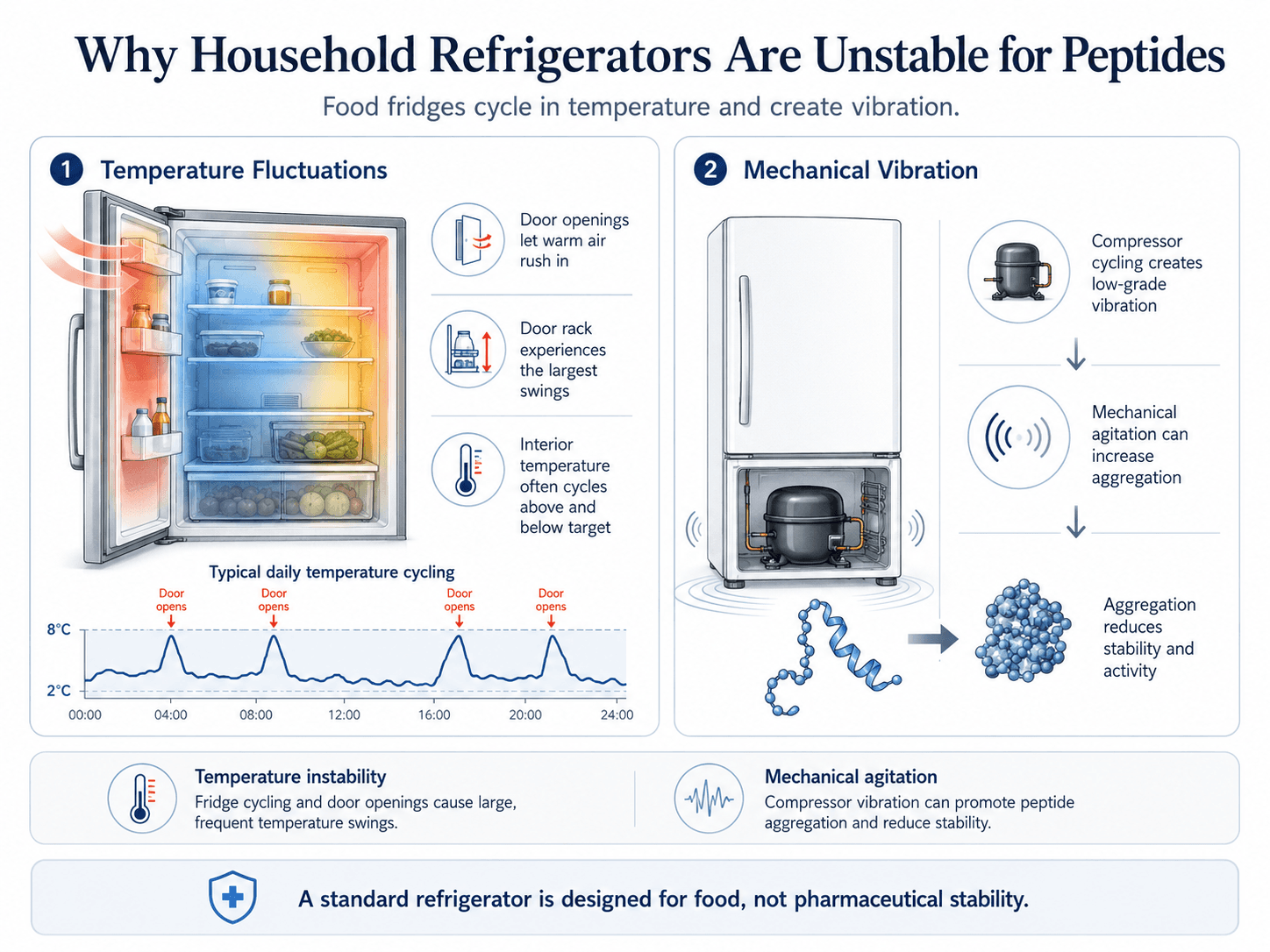
A standard household refrigerator is engineered for food, not pharmaceuticals. Its target band is roughly 2°C to 8°C, but real-world performance varies dramatically by location inside the unit, ambient kitchen temperature, and , most importantly, how often the door is opened.
Every door-open event lets warm room air rush in. The compressor responds by overcorrecting on the cold side. Vials placed in the door rack experience the largest swings of all. It is normal for interior temperature to cycle several degrees above and below target across a single day in a busy household fridge.
There is also the compressor itself. Compressor refrigeration works by cycling a refrigerant gas through compression and expansion, and that cycle produces vibration. Sustained low-grade vibration in protein and peptide solutions is associated with increased aggregation, the same failure mode that ruins shelf life. Your compounds are not just experiencing temperature instability; they are experiencing mechanical agitation around the clock.
03, Thermoelectric Precision
Why we use Peltier, not a compressor
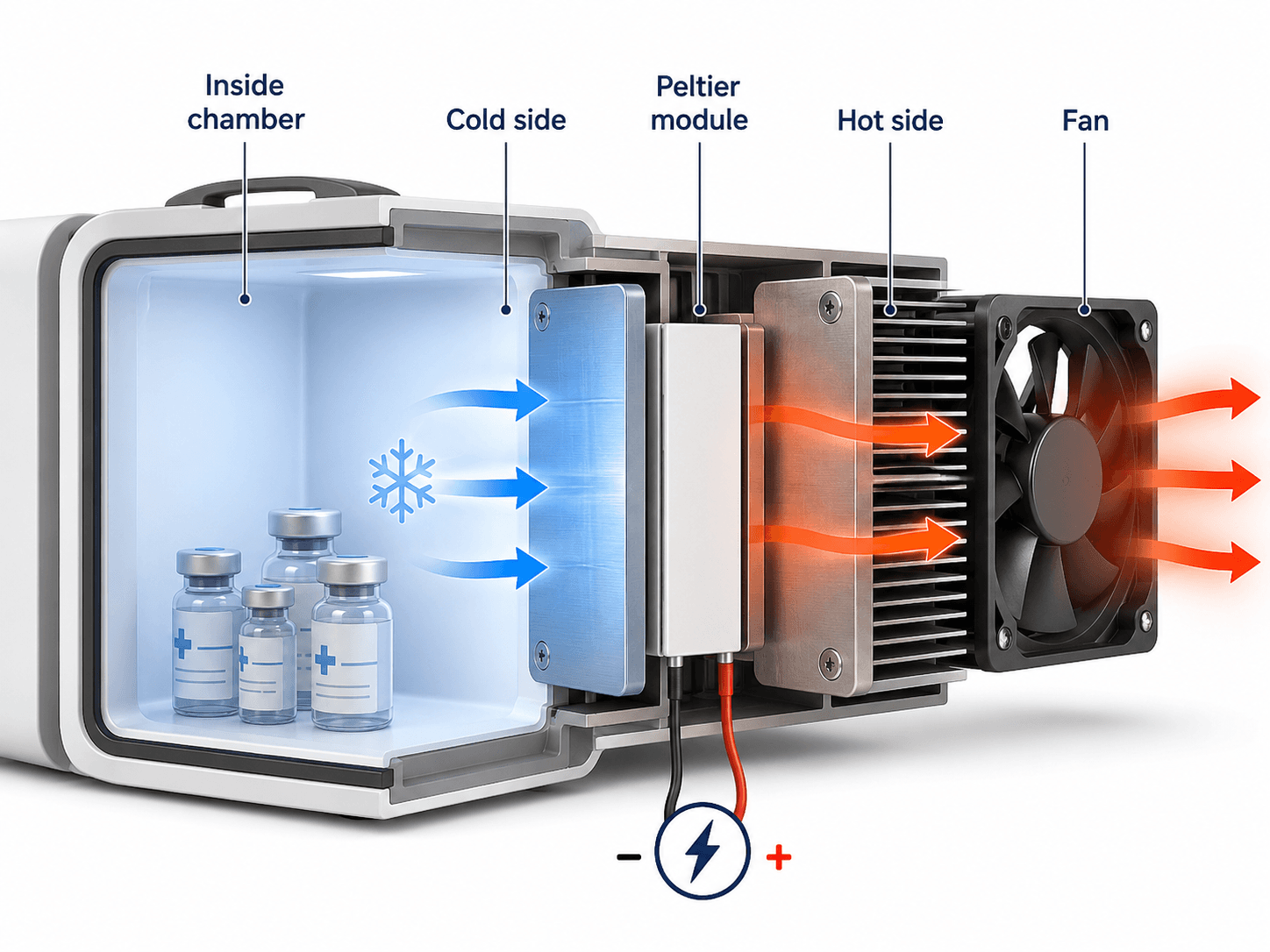
Thermoelectric cooling, also called Peltier cooling, uses the Peltier effect to move heat across a solid-state semiconductor junction when current is applied. There is no refrigerant, no compressor, no moving fluid. Just two ceramic plates and a small fan to dissipate waste heat from the hot side.
For a small thermal load like a tray of peptide vials, Peltier is the right tool. It maintains a tighter, more stable target temperature than a compressor cycling on and off. It produces no measurable vibration. And because there are no mechanical pumps or refrigerant cycles, it operates at sound levels well below 30 decibels, quieter than ambient room noise in most homes.
The trade-off is efficiency at large temperature differentials. Peltier modules are not what you want cooling a chest freezer. They are exactly what you want holding a precise small-volume target like 2°C, indefinitely, with no vibration and no audible signature.
04, Specification
How the DB90 is engineered

Temperature range
1°C, 20°C
Target temperature
Holds 2°C
Cooling technology
Solid-state Peltier
Operating sound
Under 30 dB
Vibration
None measurable
Power
USB-C / 12V
Every choice, Peltier over compressor, USB-C over wall-only, sub-30dB over standard fan profiles, was made to solve one problem: hold reconstituted peptides at specification, in a unit small and quiet enough to live next to where you actually use them.
Every vial you have stored in a kitchen fridge since reconstitution has been subject to the mechanisms above, compressor cycling, door-open temperature swings, low-grade vibration. The DB90 eliminates all three. That is not a marketing claim. It is what the specification table above describes.
Stop letting your
compounds degrade.
You’ve spent real money on your compounds. The science is clear that storage decides what dose you actually get. The DB90 was built to solve this, and only this. Order Now before the next production batch closes.
Order Now